Wednesday, January 30, 2013

Simple Warm Hat

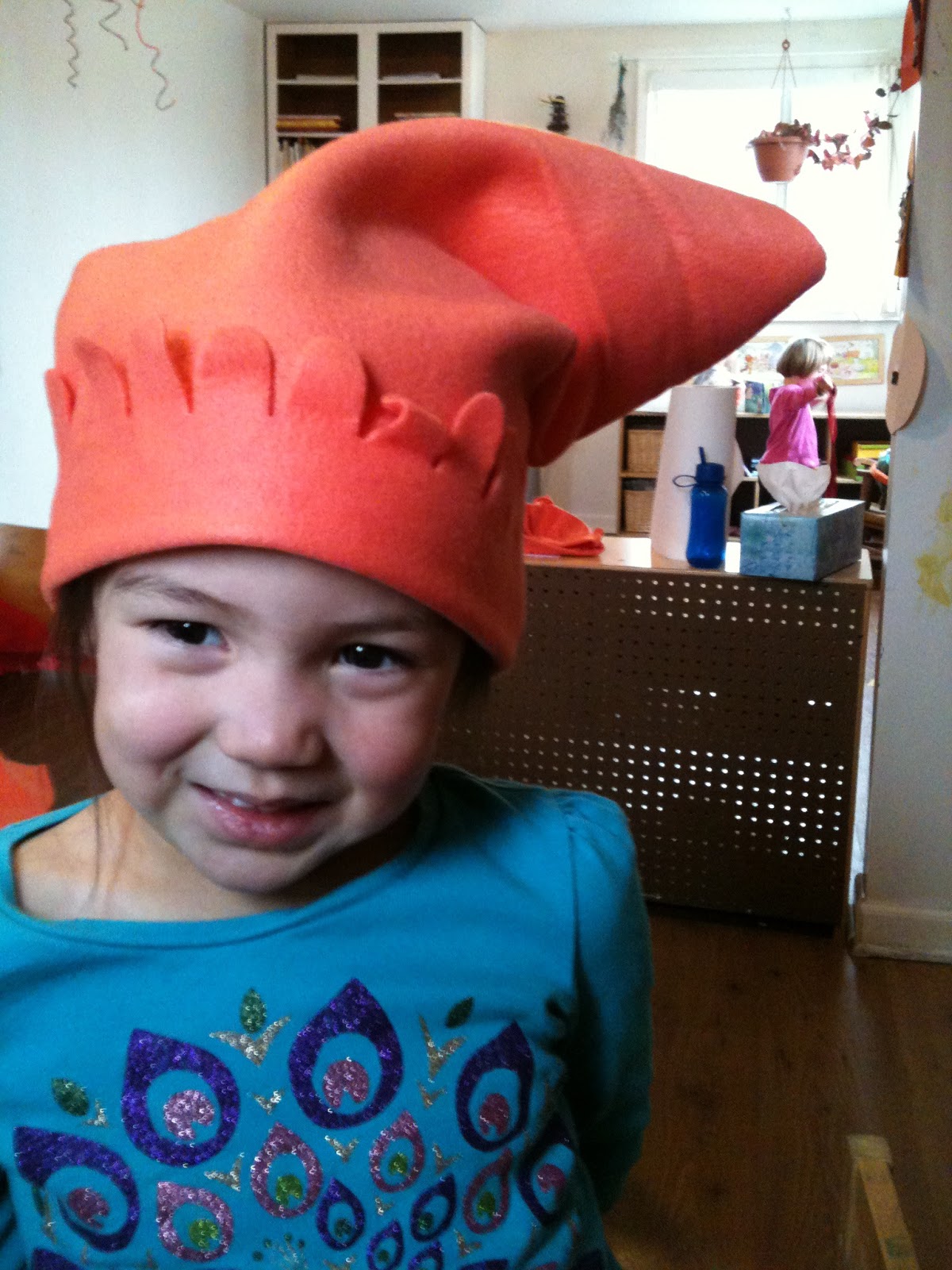
I decided that in this week of talking about dressing for the cold, each of our preschoolers would have the opportunity to sew themselves a warm hat.  I was happy to find such a simple process for this.  It goes like this:

1. Cut a strip of fleece about 12-14 inches wide.


2. Measure around the kid's head to see how big to cut it.

3. Let the kid sew the two ends together, to make a tube shape.

4. Put the tube on the kid's head, and hold where the top of the hat should fit with your hand.


5. Cut the fringe on top by simply cutting 1/2 inch strips all the way around (about 3-4 inches down from the top). I did this by holding with my hand where the top of the kid's head came, and cutting one line from the top to that point.  Then, laying it flat to cut the rest of the fringes.


6. Tie off the fringe with a strip of fleece.  The kids learned to criss-cross, then dip through the loop, then pull it tight.


7. Place on the head of your adorable child and watch for the glimmer of pride to shine through their eyes.


Puddle Boats

This is the kind of thing that happens when, as a program and as a teacher, you open yourself up to the possibilities that lie within the framework of child-led learning.  Our theme for the month is snow, and for the week it's dressing for the cold.  Well... this week has been more like spring than winter.

This morning, at drop-off, I was having a conversation with one of our kids about how our yard was literally like a lake yesterday, the sand box being an island.  We talked about puddles, big and small, and what fun we can have in them.  He mentioned that at home he likes to make boats with his dad.  So, I asked him if he thought we should make boats in our lake-puddle.  His face lit up, and he said, "Yeah, then we can be pirates!"

Seeing the wheels of imagination turning is a wonderful thing.

So, instead of offering an art choice that involved mittens, I grabbed an empty tub and filled it with egg cartons, pipe cleaners, corks, and duct tape.  I brought it out, and we gathered wet sticks.  The kids came up with lots of different ideas about how to make boats, and were enthusiastic about trying them.  We discovered that if the egg cup are facing up, they will fill with water, and the boat will not float.  If we turned them facing down, they worked much better.

So much to learn in one little idea that came straight from the mind of a preschooler!


Saturday, January 26, 2013

MLK


We spent the week before MLK day learning about him and his work.  First we learned how to say his name, and we looked at his picture, until the kids could recognize him and say his name.  Then, we talked about what is fair and what is not fair.  Would Martin Luther King say it is fair to only let people with curly hair eat lunch here?  NO. Would he say that all kids, no matter what they look like, can eat here with us?  YES. One day we talked about what is a dream and what does it mean?  We read a lot of books about skin, and talked about our skin just being a covering for who we are inside.  The concept of diversity was introduced via colors.  What would it look like if all the cars were white?  Boring.  What if everyone always wore a red shirt?  Boring.  We painted outlines of our hands and bodies with lots of colors.


Wednesday, January 23, 2013

Color math concepts

What is your favorite color? This is a more dynamic question than one might think.  Some kids recognize that their favorite color changes, even on a daily basis.  Some are committed fully to one color, others committed fully to all the colors.  Some kids can't choose just one, but can easily identify 2 or 3 favorites.  When I was a child, this question is the one thing I remember consistently lying about.  I told people my favorite color was yellow, when really, it wasn't.  My reason for this lie was that I felt sorry for yellow, because nobody ever chose it.  I wanted yellow to have at least one dedicated fan! With this logic today, and in this environment, I would have chosen orange.  Once we established who liked what color, we charted it, and talked about which color the most people chose, which color the fewest people chose, etc.  When I pointed out that nobody chose orange, at least one of the kids called out, "Yes, I like orange, because I like all the colors." So, indeed, it is deceiving to have that empty space next to orange, because the "like all" kids include it.


Tuesday, January 22, 2013

Free outdoor play

To many who are reading this, the benefits of free outdoor play may already be evident.  So, at the risk of preaching to the choir, I  want to highlight this benefit.

When they play, kids are not just goofing off.  They are doing serious work, and learning every minute of it.  Their job in their play is to create their own world.  Yes, this may involve actually creating physical structures, or elaborate scenes.  But, it's more than this.  They are establishing norms with their peers, creating their own culture.  If you think of a child's life and perspective, much of what they encounter is already decided for them.  Adults all around them are telling them how to be in this world. In their moments of play, they have the freedom to be what ever they want, with whatever cultural norms they establish.  Sometimes it amazes me how much time is spend on the negotiations of who is what, and in what relationship with whom.  But, that's the work.  The work is in establishing this social network.  The work is also in physically figuring out what works best on top of/beside/beneath what when building or creating.


One thing I love about free play being outside is that there is a sense of space and freedom.  When the kids are outside, they drift freely between different projects or different play cultures.  On the day this structure was built, a small group of them worked hard to figure out how to build it.  Then, they dispersed and found other things they were interested in: some chasing chickens, some chipping ice, some rolling down the hill.  Periodically, they would come back to this and make some change or addition to improve it in some way.  Or, they would talk about who lives there, and where the different rooms might be.  There are likely few things in their life that are like this.  Most times, when kids work on something, it is put away when they are "done."  It's rare that something they are working on remains for them to return to at will.  It's the nature of being outside, with lots of interesting adventures to be had, but plenty of space and no agenda ruling the time that is put into it.  It's their experience of flow.

Thursday, January 10, 2013

Rules

I'm convinced this exercise will always bring about insightful, interesting results: Spend lots of time with the same group of people, without really defining, out-right, what your social norms are.  Then, after a time, come together and ask the group what they think the rules are. 


This is probably especially entertaining with young kids.  We did it today, and the things they said were full of surprises.  Some kids had really insightful ideas that we didn't expect.  Others said things that made us wonder where the idea was generated.  Some responses had a perfectly clear source attached to them. Not only was it telling of what their experience in our own little culture is, but it was also telling of what is being communicated to them, here or elsewhere, in one way or another.  

I presented the idea as such: First, asking them if they know what a rule is.  Lots of answers of both "yes" and "no" ensued.  Ultimately and together, we came up with this definition: Rules are things you should do or you shouldn't do.  So, I told them I wanted to make a list of the things we should do here at our school, and the things we shouldn't do.  Here it is:


I think there will be more rules added.  I consider this a very organic list, so maybe after awhile, I will post the change we have seen in it.


Ice

This morning, upon arrival, our yard was covered in ice.


Yes, it poses a higher risk than usual, and there were times this admittedly made me nervous.  But, the kids were safe, and one of the benefits of spending lots of time outside is actually the inherent risk involved.  If they don't experience some of that, they can lack in confidence.  Another perk the outdoor play provides is the vast menu of "work" opportunities!  In all kinds of weather, there is "work" to be done.  Some is hard, some not so hard, but all of it is real.


For these kids, this morning, the ice was the perfect opportunity for them to be workers.  They found the garden hoes and chipped away at the ice, prying up bricks, boards, tools, sticks, that were covered in the ice.


 I didn't see one kid working alone.  All the chipping projects were group projects, and it was clear that they all knew they needed each other.  They shared not only in the work, but in the satisfaction of success!  Pulling up the object that had been held fast in the ice was such a thrill for all to enjoy!!


Wednesday, January 9, 2013

Snow much fun!

We have been having a lot of fun in the snow these last couple of weeks!  We're lucky to have a rich diversity of terrain, including a hill just the right size for toddler and preschool sledding.  Many times, as I've observed all these little bodies making their way through the snow, I wonder at all their brains are learning.  Whether the snow is light and fluffy, deep and stiff, or even icy on top, it provides a new challenge to their systems that is so good for growth.  I wanted to share a few of the ways snow play is encouraging their development.

Physical development: Snow play provides a sensory experience for them through tactile, temperature, and taste.  Walking in snow is not unlike walking in sand, the way it shifts beneath your feet with each step.  This provides a new challenge to walking and running that helps them to become more agile on their feet.  With each step, they are improving their strength as the snow slips back a little.  They are also improving their balance, because with the unsteady surface, the brain and body must be always communicating to find the proper center of gravity.


Proprioceptive development: The proprioceptive system is what allows us to understand where our bodies begin and end in space.  Each time these young ones take a step in the snow, they don't know exactly how far down their foot will go, before hitting firm ground.  The proprioceptive system is also responsible for us understand how much force is needed in order to change in object.  In the snow, the kids are constantly testing this out: making snowballs, digging ice, shoveling snow, building snowmen and other structures, pushing themselves down the hill on the sled, pulling up friends on the sled, etc.


Temporal Awareness: Footprints in the snow passively teach these children how far they have come.  They can look back at their footprints, and understand the passage of space and time in a visual way.

Physics Lesson: Playing in the snow allows children to experiment with gravity.  They build and lift and roll and throw.  They feel the gradual-then-quick motion of starting at the top of the hill and sliding down on the sled.  They learn how to pack snow in a ball, roll it into a bigger and bigger and BIGGER (have you seen our's?) ball.  They try to lift it, push it, watch it roll down the hill. These are all Physics experiments.


Creative Problem Solving: Yes, there are always creative problem solving opportunities, but snow play provides some new ones: pulling each other in the sled, working together to build something or push something up the hill.  Today it was how to get the sled up the hill when one friend doesn't want to get out of it.


Then, lest we forget to mention snow play is SNOW MUCH FUN!! Part of what is so great about it for the teachers is that the kids are busy and having a blast doing their very important work, growing their brains with every step and pat of their hands.  This is a wonder to witness!

Wednesday, December 19, 2012

Intro to a graph


Today we decided to introduce the concept of a graph to the kids.  I don't think it's academically important at this age, but it is interesting to them, so that in itself makes it important.  We took our list of where we see light, and the kids decided whether they see light in each of the items during the day, the night, or both. Then, we counted how many day lights and how many night lights we had on our list, and graphed them.  It was good counting exercise.  The graph was a nice visual, and it was good for them to recognize the difference between the two bars: size, height, design (it bothered one kid enough that they didn't match, that he mentioned it much later in the day).


This Little Light

For pure enjoyment.  These sweet little voices make me so happy.


Songs to practice impulse-control

Here are a couple examples of songs we use to practice impulse control.  In the first, they have to wait to play their instruments, and in the second, they have to stop playing their instruments.  It's good, hard work!

In this one, the kids are working hard to keep their bells quiet until the person in the middle "wakes up!"


 In the second, we are practicing counting, steady beat, and impulse control.  They are working hard to stop after clapping 3 times.  In the song, we start by clapping and saying, "1, 2, 3 (stop!)"  Then we transition to "sea, sea, sea (stop!)"  Finally, we do the song with only clapping, and no words on the claps.

Thursday, December 6, 2012

Love-Light

It's a word that we use to describe the love that comes from inside and shines through our eyes when we give our love to others. This month, our theme is light, which is a theme I love working with!  We started out brainstorming where we see light.  Most of the obvious places came to mind:


One of our kids mentioned the light in your eyes.  This was amazing to me.  She is a very bright little preschooler, who can speak 2 (maybe 3?) languages.  She learns music quickly and accurately, and seems to have a knack for several levels of communication.  Considering this, it makes sense that she would notice something like light in the eyes.

So. . . we went there, and talked about what it means when someone says, "light in your eyes." We named it love-light.  The best I could do is tell this engaged group of preschoolers that they all have love inside their little bodies, and when they let that love come out, that is their love-light.  We can see the love inside someone else's body when it shines in their eyes.  Our theme song is "This Little Light of Mine."  We hold our fingers up as a pretend candle.  When I ask them, "Is that a real candle you're holding?" or "Are we really singing about a candle?" They say, "Nooooooo," like the question is the silliest they've ever heard.  Then we talk about how "let your light shine" means letting your love-light shine by loving other people or things.  We will talk about this repeatedly throughout the month, because repetition plants seeds at this age, and our job is planters.

This first week of the month, we have focused on the light around us, too.

Sun coming through windows, made into "stained glass"
Flashlight tag
Drawing and measuring our shadows
Building a house with blocks, and trying to keep all the light inside
"Candle" lit lunch
Mystery lights that come on and off when you talk to them, or blow them, or smile at them
Sun and moon stories and songs
Finding out what happens when we add white paint vs. black paint?
Sun bread
Light and the absence of light


Friday, November 30, 2012

My house

Part of our family theme this week involved making a family with our blocks.  We drew the kids on some blocks, and built a house for them.  It included a fridge and couch, but that's about all we seemed to need.  


Then we made our houses with paper shapes. There was a lot of variety, and some of the kids just wanted to use the time to practice their cutting skills. 


Monday, November 26, 2012

Sad Chickens

Today was a sad day for the chickens.  They lost one of their own.  It was quite a surprise for all of us.  We were out in the yard with all 4 of them in the morning.  We went in for snack and circle time from 9:30-10:30.  When we were back out in the yard after that, one of the chickens was making a lot of noise by the fence, and was clearly upset.  At first, when Mr. Lyman went to check it out, he found a flurry of feathers and knew if wasn't good.  Then, he found the poor dead chicken, right by the fence.  The chicken friend carried on for quite awhile, and the other 2 chickens were nowhere to be seen.  We looked and looked for them, everywhere the kids suggested: in the toddler area, in their coop, in the compost pile.  But, we couldn't find them.  We developed theories about what happened. Who did this? Some ideas: a bear, a wolf, a coyote, a fox, a shark, a hawk.  Where were the others?  Did they get carried off?  Did they escape the fence and run away?  

Then, someone suggested the bush in the far corner of the yard.  We looked, and the 2 other chickens were tucked in the bush, hiding.  Poor things were probably terrified, but they were alive and well!

Although it was a traumatic event for our chickens, the kids did not seem very shaken by this event.  They looked at the dead chicken (which we carefully put on the other side of the fence, so there was no danger of anyone touching it), and were very engaged in solving the mystery of it.  Some of them were concerned about the other chickens, and wanted to comfort them.  One kid jokingly asked if a coyote would eat them.  No one was very distraught by it all, though.  It was amazing to all of us that a fox or coyote would sneak into the yard and take a big bite out of one of our chickens right in the middle of our day.  

Here's a video of the brave chicken who stood by her friend, making a fuss.  She wouldn't leave the dead chicken's side, as she paced and clucked.

And here is a video of our discovery of the other 2 chickens, who were alive after all.

Sunday, November 25, 2012

Cancer and Friendship

One of our strong little beings is standing up against cancer, fighting the good fight.  She's been brave, and we are proud of her.  We also can't wait to see her again, and have her among us again.  We miss her.  The kids ask about her, and one reported dreaming about her.  To show our love and support, we assisted the kids in making a quilt for her.  We were able to decorate the hand prints and sew it together as a group (yes, with the kids helping to sew it with the machine) in time for her third birthday.  

Earlier, when she was spending her days in the hospital, we made a card that included hand prints, too. I like to use the hand prints, because it is a representation of the kids and teachers that can be seen by their varying size and shape.  I also like it because it is easy to pretend that those hands are there with her, hugging her, rubbing her back, holding her hand, playing guitar, and whatever else a friendly hand might do.  

Stay strong, little friend.  We love you and miss you.


Tuesday, November 20, 2012

Thanks giving

First, I give thanks to the parents, who trust us with the care of their children -- no small task!
I give thanks for the precious little lives I get to spend my days with.
I give thanks to their lively little minds that bring me cheer, laughter, and wonderment.
I give thanks for the expressions on their faces that tell whole stories.
I give thanks for the noises they make, loud and soft, verbal and nonverbal.
I give thanks for the challenges I face: opportunities to grow.
I give thanks for the perspective they bring to my life.  Seeing through their eyes is colorful!
I give thanks for small hands that appear in my big hand.
I give thanks for the cuddles and hugs, my "blankets."
I give thanks for the way these small people can move in big ways.
I give thanks for the chance to witness how they use their creative minds.
I give thanks for whole small bodies, crashing into mine (yes, even if I'm surprised).
I give thanks for little bodies who end up in my arms.
I give thanks for outdoor space, and our commitment to spend time there.
I give thanks for my coworkers, who speak with love in their voices.
I give thanks for my coworkers' creativity and love of imagination.
I give thanks for the respect I see for children where I work.
I give thanks for mittens and hats and snow suits that keep these little bodies warm.
I give thanks for healthful food that is devoured by these little mouths.
I give thanks for the community that has developed here.
I give thanks for work that welcomes me and my child together.
I give thanks for work.
I give thanks for the opportunity to give my gifts in a meaningful way.
I give thanks for the chance to learn every day.
I give thanks that this tender beginning of life is there for me to witness and be actively present in, even as I watch my own kids grow past it.

Sunday, November 11, 2012

Tone

"When someone loves you, the way they say your name is different. You just know that your name is safe in their mouth." 
Billy - age 4 

This topic of tone of voice has come up a couple times for me lately.  It's powerful stuff.  While some people are more sensitive to tone of voice than others, based on their personality (introverts are more sensitive to it than extroverts, for example), I am also developing a theory about tone of voice and young children.  Here it is:

I think that young children are more sensitive to tone of voice than we adults are.  The reason I have developed this theory is not only from experience.  Yes, I have experienced the way young children are keenly aware of body language and tone of voice.  However, my theory is based not only on that, but also on the development of language.  Young children are closer (much, actually) to the nonverbal stage of life than we are.  Some are still emerging from it.  In the non-verbal stage, they were used to communicating without words.  Their reliance on non-verbal cues mades them sensitive to subtle changes in body language, etc.  Yes, we all were in that stage at one point.  I think that since they are closer to that stage, that maybe they subconsciously remember what it is like, and have retained some of the skills they developed during that stage.  

Because they are closer to their non-verbal stage than we are, they are more sensitive to the non-verbal cues.  Because they are more sensitive, it is even more important for us as adults to pay attention to our own non-verbal cues.  The tone of our voice can tell them much more than our words do.  The expression on our faces tell the volumes about how we are feeling, and maybe even what we are thinking.  Our body language can be enough to make them feel vulnerable or confident.  Raised eyebrows vs. a slightly furrowed brow; crossed arms or open; standing tall, or squatting down to their level. . . these things all tell young children how much we honor and respect them; what feelings are really behind our words; whether we are judging them or accepting them.  

It's a delicate task to keep not only every word, but our posture, our tone of voice, our facial expressions all positive and receptive and loving.  Of course we want to give them love, and we want them to be receptive.  As caregivers, if we want them to receive love from us, we need to not only use loving words, but a loving tone, and safe, receptive body language.  This is a constant challenge for us, but an important one.

We need to keep their names safe in our mouths.

~ Katie